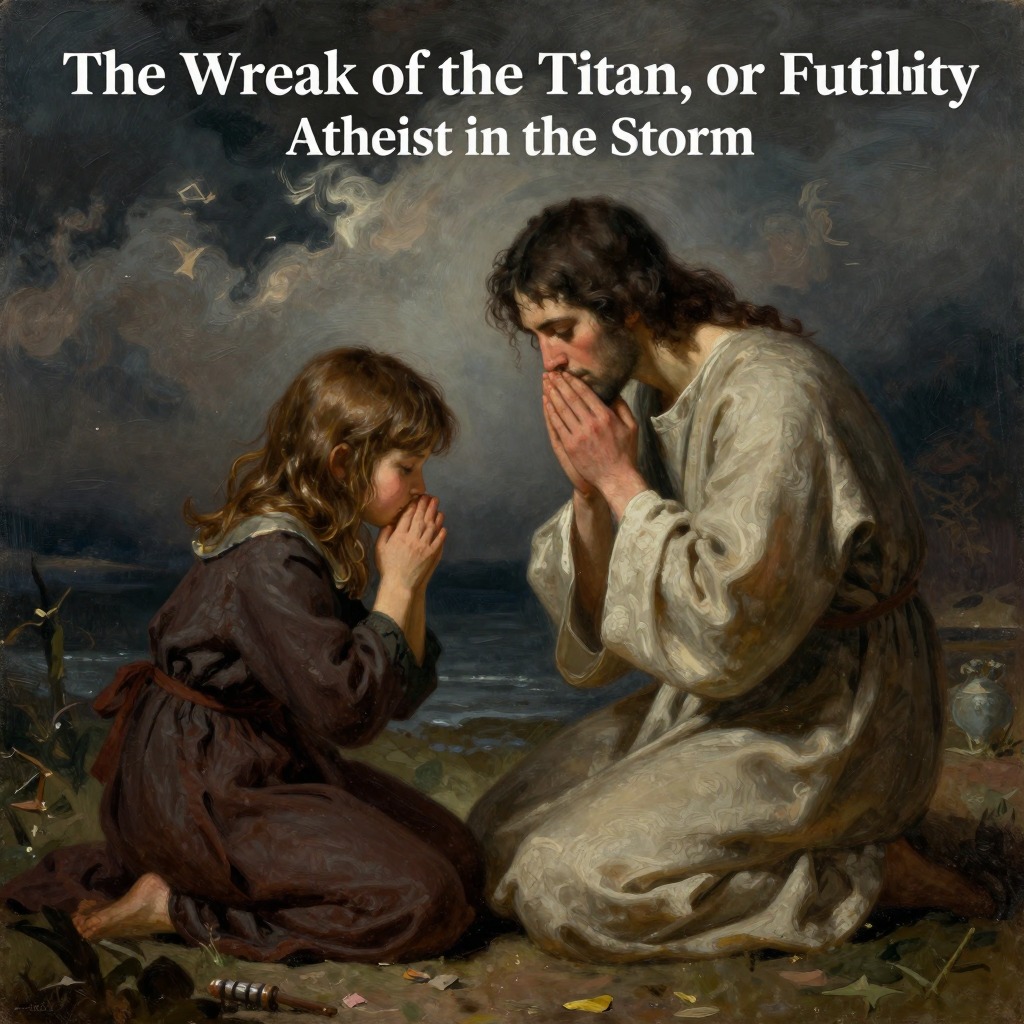
The unspeakable hunger of a love that had failed
The phrase "The unspeakable hunger of a love that had failed" is a pivotal expression in Morgan Robertson's novella The Wreck of the Titan, capturing the essence of John Rowland's tragic, unrequited love for Myra Selfridge. It appears at the climax of Rowland's drug-induced hallucination on the bridge of the Titan, where he is overwhelmed by the memory of his lost love and the emptiness of his life. This phrase not only defines Rowland's emotional state but also serves as a thematic anchor for the novel, exploring the destructive power of love, the nature of suffering, and the possibility of redemption through selfless action.
Origin and Context
The expression first emerges in Chapter Six, during Rowland's night watch on the bridge, after he has been secretly drugged with hasheesh by the ship's officers. As the drug takes hold, Rowland slips into a visionary state, imagining himself adrift in a gray, limitless void. In this hallucination, he sees himself and Myra on opposite edges of space, calling to each other but unable to connect. The narrator describes his emotional state as "the unspeakable hunger of a love that had failed," a phrase that distills the agony of a love that has been lost and can never be reclaimed. This moment is preceded by Rowland's earlier reflections on his love for Myra, whom he had known as Myra Gaunt before her marriage to George Selfridge. He recalls how her rejection and his subsequent disgrace led him to a life of alcoholism and despair, and he muses on the injustice of a universe that seems indifferent to his suffering.
The Nature of Rowland's Love
Rowland's love for Myra is portrayed as an all-consuming, almost pathological obsession. In his internal monologue, he questions why the loss of one woman among millions can outweigh every blessing in life and turn a man's nature into a hell. He describes his love as "the dying flutter of a starved love," a phrase that echoes the later expression, suggesting a love that is both vital and doomed. Rowland's love is not merely romantic; it is tied to his sense of identity and purpose. He confesses that he does not love Myra's soul, but her physical beauty, her voice, her grace, and her charm. This admission reveals the depth of his earthly, human attachment, which stands in stark contrast to the spiritual ideals he later questions. The "unspeakable hunger" thus represents a desire that is both insatiable and inexpressible, a longing that words cannot fully capture.
The Vision and Its Aftermath
In the hallucination, Rowland's love is depicted as a force that transcends even the boundaries of space and time. He sees himself and Myra as two clouds of nebula, resolving into myriad points of light, and he hears her voice calling, "Come back to me." Yet the two cannot understand each other, and the vision ends with Rowland alone, facing a formless darkness that represents the evil of his life. This vision is interrupted by the arrival of Myra's child, who sleepwalks onto the bridge, and by the lookout's cry of "Ice ahead." The phrase "the unspeakable hunger" thus marks a moment of profound psychological crisis, from which Rowland is abruptly pulled back to reality by the impending disaster. The vision also foreshadows Rowland's later actions, as he will risk his life to save the child, driven by the same love that has caused him so much pain.
Thematic Significance
"The unspeakable hunger of a love that had failed" is central to the novel's exploration of love, loss, and redemption. Rowland's love for Myra is the driving force behind his actions, from his initial despair to his heroic sacrifice on the iceberg. The phrase encapsulates the idea that love, even when unrequited, can be a source of both suffering and strength. It also reflects Rowland's atheism and his struggle with the concept of a merciful God. In his vision, he denies the existence of a loving deity, affirming instead the "integrity of cause and effect" and the "survival of the fittest." Yet, later, on the iceberg, he prays to the God he denies, begging for the safety of the child and her mother. The "unspeakable hunger" thus represents the tension between his rational skepticism and his emotional need for hope and connection.
The phrase also resonates with the novel's broader critique of modernity and the dehumanizing effects of technology and capitalism. The Titan, a symbol of human pride and technological hubris, is destroyed by an iceberg, and Rowland, a broken man, is the one who survives to expose the company's negligence. His love for Myra, though failed, gives him the strength to act selflessly, and in doing so, he finds a measure of redemption. The "unspeakable hunger" is thus not merely a personal lament but a commentary on the human condition, the search for meaning in a world that often seems indifferent to individual suffering.
Recurrence and Resolution
The phrase "the unspeakable hunger" does not appear verbatim again in the text, but its thematic resonance persists throughout the novel. Rowland's love for Myra continues to shape his actions, even after he is rescued and brought to London. He refuses to testify against the Titan's officers, not out of spite, but to protect Myra's child from the financial ruin that would follow. He later travels to New York to return the child to her mother, enduring arrest and humiliation in the process. The "unspeakable hunger" is ultimately transformed into a selfless devotion to the child, whom he calls "Myra" and for whom he sacrifices his arm and his future. In the end, Rowland achieves a kind of peace, finding a new purpose in life and overcoming his alcoholism. The phrase thus serves as a reminder of the enduring power of love, even when it is unfulfilled, and the possibility of finding meaning through self-sacrifice.